Why AI Can't Replace Your Plumber (But It Can Answer Their Phone)
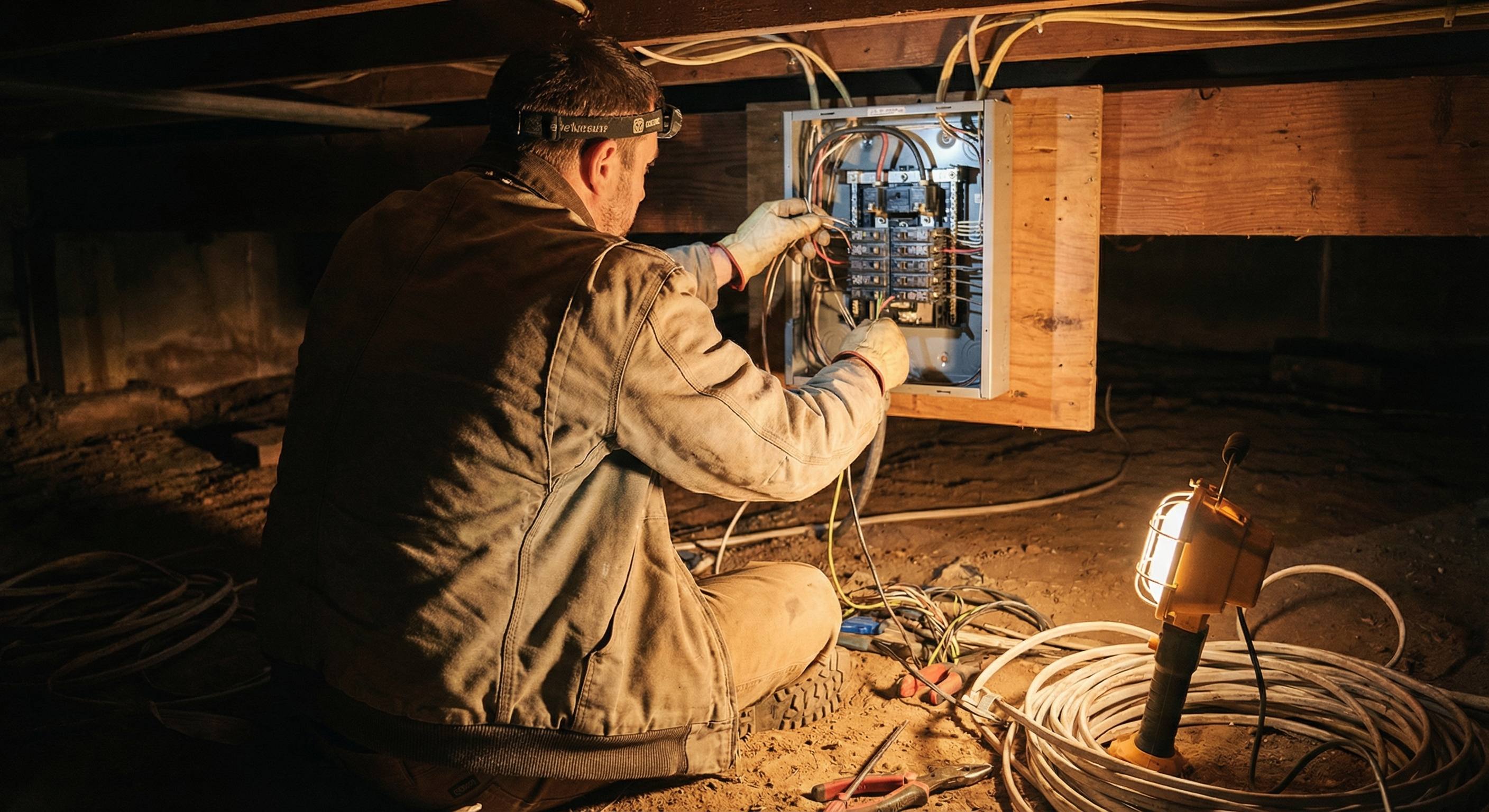
Skilled trades are among the most AI-resistant jobs on the planet. The irony? They stand to benefit more from AI tools than almost any other industry — and most tradespeople haven't figured that out yet.
The Jobs No Algorithm Can Touch
Picture a busted pipe flooding a basement at 11 p.m. Now picture a robot navigating that chaos — crawling through a cramped utility closet, reading a system installed in 1987, making split-second decisions based on water pressure, pipe age, and the smell of mildew. It's not happening. Not in 2026. Probably not in 2036 either.
This isn't just intuition. Forbes has consistently ranked skilled trades — plumbers, electricians, HVAC technicians, welders — among the most AI-resilient occupations in the economy. The physical, unpredictable, judgment-heavy nature of the work is precisely what makes it so hard to automate. A language model can write a sonnet or summarize a legal brief. It cannot snake a drain.
Mike Rowe, the longtime advocate for blue-collar work, put it bluntly in a widely-shared interview: "They're not coming for the welders." His point was simple — the trades require presence, adaptability, and hands. No amount of machine learning closes that gap.
"They're not coming for the welders." — Mike Rowe, trades advocate and host of Dirty Jobs, on why physical skilled labor remains beyond the reach of automation.
The Data Is Telling a Different Story Than the Headlines
Turn on the news and the narrative is relentless: AI is coming for everyone's job. White-collar workers, programmers, paralegals, accountants — all facing disruption. But scroll past the clickbait and the picture gets more complicated.
The World Economic Forum's Future of Jobs Report projects continued growth across skilled trades through the end of the decade. The shortage of trained electricians, HVAC technicians, and plumbers in the United States isn't a temporary blip — it's a structural gap that's been building for years and shows no signs of closing. Trade school enrollment has ticked upward, but demand consistently outpaces supply.
The result: tradespeople are busy. Often too busy. That busyness comes with a hidden cost — the administrative work that piles up when the focus is entirely on the job in front of you.
The World Economic Forum's Future of Jobs Report projects skilled trades among the top growth occupations through 2030 — driven by infrastructure investment, aging systems, and a persistent shortage of trained workers entering the field.
The Hidden Tax on Every Trade Business
A master electrician running a three-person crew doesn't spend all day on the tools. There are calls to return, quotes to write up, scheduling conflicts to untangle, reviews to respond to, and new customers to follow up with. Every hour spent on that overhead is an hour not spent on billable work — or on rest.
Industry research consistently finds that service businesses miss a significant portion of inbound calls, not because they don't want the business, but because they're on the job and can't pick up. A missed call from a homeowner with a leaking water heater doesn't wait — that customer moves on to the next number in the search results. The job is gone before the voicemail is even checked.
This is the operational gap that AI tools are uniquely positioned to close. Not by replacing the tradesperson — but by handling the parts of the business that don't require a wrench.
What AI Actually Does Well for Trades Businesses
The most practical AI applications for trade businesses aren't glamorous. They're unglamorous in the best possible way — quietly solving the problems that cost real money every single day.
AI-powered phone answering handles inbound calls 24 hours a day, seven days a week. It can qualify the caller, collect the relevant information, book appointments directly into a scheduling system, and send confirmation texts — all without a human ever picking up the phone. For a plumber finishing a job at 4:30 p.m. when the after-hours calls start rolling in, this isn't a luxury. It's the difference between capturing that revenue and watching it walk across the street.
Automated follow-ups and review requests turn satisfied customers into online advocates without requiring a single manual action. A text sent two days after a completed job asking for a Google review, with a direct link, converts at a far higher rate than hoping customers will find it on their own. More reviews mean higher rankings in local search. Higher rankings mean more inbound calls. The cycle compounds.
AI-assisted marketing — even something as basic as a well-maintained Google Business Profile with consistent posting — signals to the algorithm that a business is active and worth surfacing. Most trades businesses are competing against others who are doing the bare minimum. The bar isn't high, but clearing it requires showing up consistently in a way that most owner-operators simply don't have time for manually.
Forbes estimates that trades and manual labor jobs face less than a 5% automation risk over the next decade — compared to 47% for office and administrative roles. The very workers least threatened by AI are often the slowest to adopt the tools that would help them the most.
The Competitive Moment Is Now
Most trades businesses in any given market are operating roughly the same way they were a decade ago. The tools have changed on the jobsite — better equipment, smarter diagnostics — but the front office often hasn't. Phone calls go to voicemail. Scheduling happens over text threads. Marketing is word of mouth plus a Facebook page that hasn't been updated since 2022.
The businesses that move first to close this gap have an asymmetric advantage. When a homeowner searches for an electrician at 9 p.m. on a Tuesday and one business answers immediately, books the appointment, and sends a confirmation — while three others go to voicemail — the outcome is predictable. The market will sort itself. It just hasn't happened yet in most local markets.
This is the window. Not for some abstract future version of AI that runs job sites autonomously — but for the immediate, practical tools that handle the phone, the schedule, and the follow-up right now.
The Real Opportunity for Tradespeople
There's a certain irony embedded in the AI conversation that rarely gets named: the workers most insulated from AI displacement are often the ones most reluctant to engage with AI tools. It's understandable — when someone spends the day solving physical problems with their hands, technology can feel like it belongs to a different world.
But the framing is wrong. AI isn't asking a plumber to become a programmer. It's offering to handle the parts of running a business that are genuinely miserable — the missed calls, the administrative backlog, the digital presence that never quite gets attention. Those are not the reasons anyone got into the trades. Handing them off to automation isn't a compromise. It's the point.
The tradesperson who understands this is the one who captures the call at 11 p.m., books the job automatically, follows up with a review request two days later, and shows up at the top of local search results — all while focusing entirely on the work that requires their expertise. That's not a future scenario. It's available today, to any trades business willing to set it up.
No algorithm is coming for the welder's job. But the welder who uses AI to run the business side? That's the welder who wins the next decade.
Ready to Put AI to Work for Your Trades Business?
Find out how AI answering, automated follow-ups, and smart marketing can help your business capture more jobs without adding overhead.
Get a Free Consultation