The After-Hours Problem: What Happens When Your Business Closes at 5
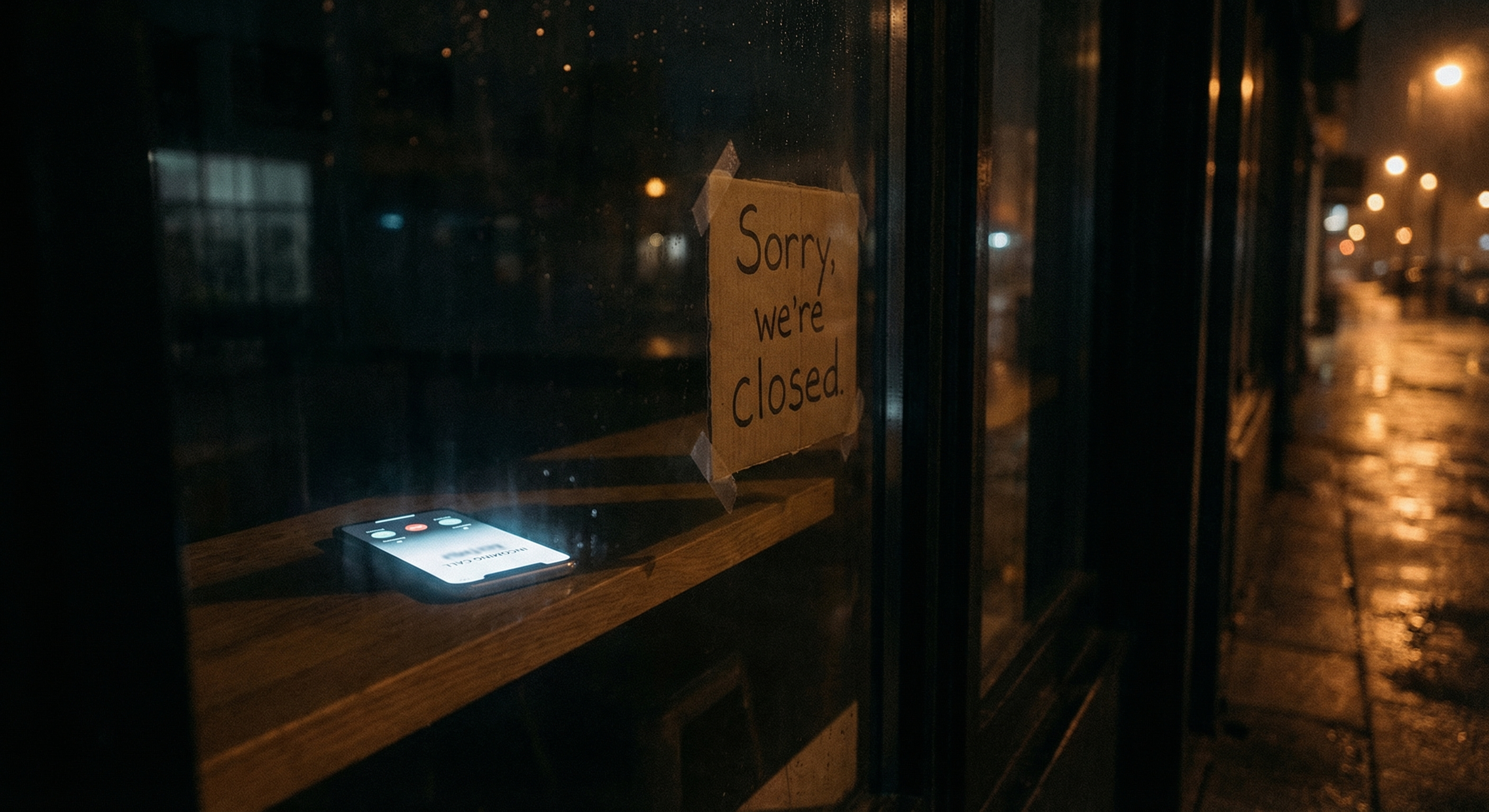
The pipe bursts at 9:47 PM. The homeowner grabs their phone and starts calling. The first plumber who picks up gets the job. The second one gets a voicemail they'll return in the morning — to someone who has already moved on.
The Hours That Actually Matter
Most service businesses operate on a clean schedule. Phones on at 8, phones off at 5. Staff clocks out, the office goes dark, and the assumption holds that customers work the same way. They don't.
Research consistently shows that more than 40% of calls to local service businesses arrive outside standard business hours. That figure climbs even higher for trades where urgency drives the call — plumbing, HVAC, electrical, locksmithing. A water heater doesn't fail during a convenient window. A heating system doesn't choose a Tuesday at 2 PM to give out. The moments that make someone reach for their phone are almost always inconvenient by definition.
For businesses that treat their phone lines like office equipment — something that gets turned off at the end of the workday — the math is quietly brutal. Nearly half of all inbound interest is hitting a wall of silence.
More than 40% of calls to local service businesses come in outside of standard business hours — and for emergency trades like plumbing and HVAC, that number is significantly higher.
Emergency Trades: Where the Gap Is Widest
Consider what actually prompts someone to call a plumber. It's rarely a leisurely decision made during business hours. A slow drain might get Googled at noon. A flooding basement gets called in at 10 PM. The psychology of the emergency trade customer is straightforward: the worse the problem, the more likely it is to surface at night, on a weekend, or on a holiday.
HVAC companies see this pattern every summer and every winter. When the air conditioning dies on the hottest day of the year, calls spike in the evening — after the homeowner has come home from work, noticed the heat, waited an hour hoping the system would recover, and finally accepted that it won't. That call isn't going to a company that closed at 5. It's going to whoever answers.
Locksmiths, restoration companies, appliance repair services, and electricians dealing with safety issues all operate in the same reality. The customer's problem doesn't care about the business's schedule. But the customer cares very much about who can help them right now.
Speed to Lead: The Metric That Determines Winners
The concept of "speed to lead" has been studied extensively in sales research, and the numbers are stark. Studies tracking lead response across industries show that the first business to respond to an inquiry wins the job approximately 78% of the time. Not the cheapest. Not the most experienced. The fastest.
This isn't a phenomenon unique to emergency trades. It shows up in home services, professional services, healthcare, and anywhere a customer is actively shopping. The moment someone submits a contact form, sends a text, or dials a number, they begin a clock. If the first call goes to voicemail, they dial again — someone else. If the second goes unanswered, they try a third. By the time a business returns that first voicemail the next morning, the customer has often already booked, signed, or moved on.
The after-hours gap isn't just about missed calls in the moment. It's about permanently losing customers who will never call back because they already found what they needed from someone else.
Speed-to-lead research shows that the first business to respond to an inquiry wins the job 78% of the time — not the cheapest option, not the most experienced. The one that answered first.
What Happens When the Competitor Answers
The scenario plays out thousands of times a day across every market in the country. A homeowner in a mid-sized city needs a roofer after a storm. They search, they find three or four local companies, they start calling. Company A has a live answering service. Company B goes to voicemail. Company C doesn't pick up either. Company A gets the call back, schedules an estimate, and has a signed contract before Company B even listens to the message.
From Company B's perspective, it was just a missed call. From a revenue perspective, it was a job that could have been worth several thousand dollars — and a customer who might have referred two or three more. The compounding effect of missed after-hours calls isn't always visible in the moment. It shows up quarterly, in slower pipelines and lower close rates, in a slow erosion that's hard to attribute to a single cause.
For businesses in competitive local markets, the after-hours gap isn't a minor inconvenience. It's a structural disadvantage against any competitor who has solved it.
How AI Phone Coverage Changes the Equation
For years, the options for after-hours coverage were limited and expensive. Hire an answering service. Pay staff overtime. Forward calls to a manager who resented it. None of those solutions scaled particularly well, and all of them introduced friction — either in cost, in quality, or in employee morale.
AI voice technology has changed the calculus. A well-configured AI phone agent can answer every call, at any hour, with no hold time and no dropped calls. It can collect the caller's name, the nature of the problem, their address and contact information, and their preferred callback time. It can provide basic information about services, pricing ranges, and availability. For emergency situations, it can escalate to an on-call technician. For standard inquiries, it can capture everything needed to turn the call into a booked appointment the next morning.
The key distinction is what AI phone coverage actually accomplishes. It doesn't replace the human conversation that closes a complex sale or handles a nuanced customer complaint. What it does is ensure that no caller hits a dead end. The lead gets captured. The customer feels heard. And the business has a fighting chance at the follow-up instead of losing the job before morning.
AI phone agents don't just take messages — they capture lead details, answer common questions, and triage urgency at any hour, so a business can follow up with context instead of a cold callback to someone who may have already moved on.
The Real Cost of Doing Nothing
Businesses that have looked carefully at their call analytics are often surprised by what they find. A roofing company in the Midwest audited three months of missed calls and calculated that the average job value in their market was $9,400. Their after-hours voicemail box had accumulated 34 unclaimed messages in that period. Even assuming a modest conversion rate, the revenue sitting in that voicemail box was significant — and it wasn't going to convert, because by the time anyone listened, it was too late.
The math for service businesses is usually simple once someone does it. Take the average number of missed after-hours calls per week. Apply the market average close rate. Multiply by average job value. The result tends to focus the mind.
The after-hours problem isn't a technology problem, strictly speaking. It's a revenue problem wearing a technology costume. The businesses that solve it — whether through AI, through better staffing, through answering services, or through some combination — aren't doing it because they love the technology. They're doing it because the alternative is leaving jobs on the table for competitors who are simply more available.
The pipe is still bursting at 9:47 PM. The homeowner is still calling. The only question that matters is whether the phone gets answered.
Missing After-Hours Calls?
Find out how AI phone coverage can capture leads and book appointments around the clock — without adding staff or overhead.
Get a Free Consultation