How to Get More Google Reviews Without Asking Every Customer
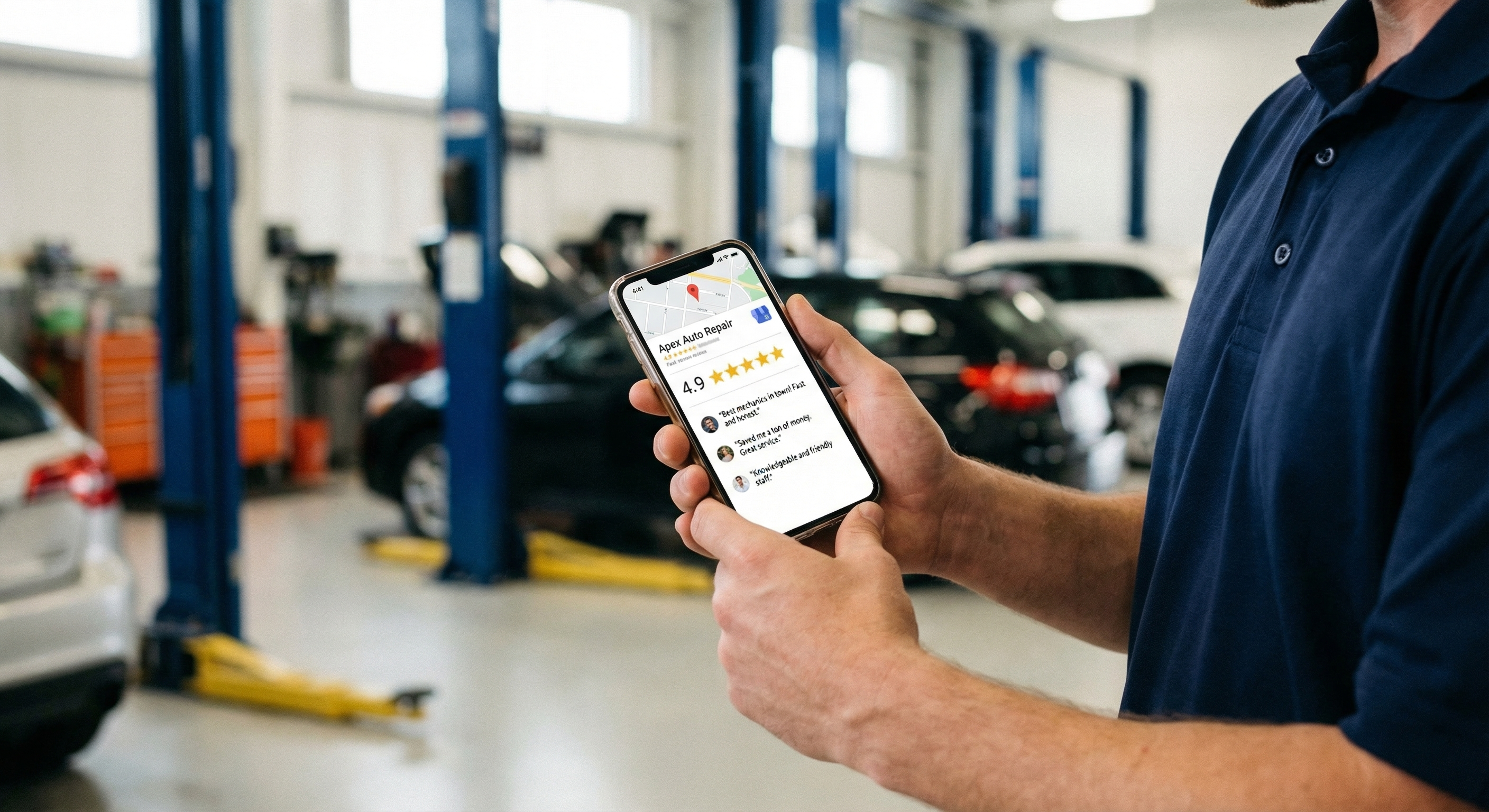
Google reviews are the single most powerful trust signal in local search—and most small businesses are barely collecting them. The fix is simpler than most owners think, and it doesn't require begging every customer one by one.
A homeowner finishes a job with a contractor she's happy with. The work was good, the price was fair, the crew left the place clean. She has every intention of leaving a review. Then she gets back to her day. Two weeks later, a prompt from Google appears in her inbox. She means to click it. She doesn't. The review never gets written.
This is the gap between customer satisfaction and customer reviews—and it's wider than most business owners realize. According to BrightLocal's annual Local Consumer Review Survey, reviews are now the number one factor in local search rankings, outweighing website authority, backlinks, and on-page SEO signals. Yet the average local business has fewer than 20 Google reviews. The businesses that dominate the local pack in competitive markets often have hundreds. The difference isn't luck—it's a system.
Google reviews are the #1 local search ranking factor according to BrightLocal—yet most local businesses have fewer than 20 reviews. In competitive markets, that gap is enough to push a business off the first page entirely.
Why Timing Is Everything
The single most important variable in review collection is timing. Research from customer experience platforms consistently shows that customers are three times more likely to leave a review when asked within one hour of job completion. The emotional peak—the relief, the satisfaction, the goodwill toward the business—is highest in that narrow window. Wait until the next day, and that peak has passed. Wait a week, and the experience has blended into the background noise of daily life.
This is why the traditional approach of asking for reviews during a follow-up call rarely works at scale. By the time the office gets around to calling, days have passed, the customer is busy, and the ask feels like an interruption rather than a natural follow-through on a good experience. The ask itself isn't the problem—it's almost always the timing.
Businesses that have built strong review profiles have almost universally arrived at the same conclusion: the request needs to be automated, and it needs to go out the moment the job is marked complete.
Requesting a review within one hour of job completion makes a customer three times more likely to leave one. Satisfaction fades fast—the window for action is narrower than most businesses treat it.
How Automated Review Request Systems Work
The mechanics of an automated review system are straightforward. When a job is closed in a field service management platform, CRM, or even a simple scheduling tool, a trigger fires a text message to the customer's phone number on file. The message is short, personalized with the customer's first name, thanks them for the business, and includes a direct link to the business's Google review page. No login required. No searching for the business. One tap and they're on the review form.
Text message is the preferred channel for this request—not email. Open rates for SMS hover around 98%, compared to email's average of 20-30%. More importantly, SMS is read within minutes. An email review request sent at 4 p.m. might not be seen until the next morning. A text arrives, buzzes, and gets opened on the spot—right when the customer still has the job fresh in mind.
Platforms like Jobber, ServiceTitan, and Housecall Pro have this capability built in, and it can be configured in under an hour. For businesses not using a field service tool, standalone review management tools like NiceJob, Birdeye, or even a simple Zapier workflow connecting a form submission to an SMS service can accomplish the same result. The technology is accessible and, relative to what it produces, inexpensive.
The message itself matters. The most effective review requests are brief, warm, and frictionless. Something like: "Hi [Name], thanks for having us out today—it was great working with you. If you have a minute, a Google review would mean a lot to us: [link]." No lengthy explanation, no multiple asks, no reminder that the business is "small" and "really needs" the review. Just a sincere, simple nudge delivered at the right moment.
What Google's Guidelines Actually Say
Google permits businesses to ask customers for reviews, but draws clear lines around how that asking can be done. Incentivizing reviews—offering discounts, gift cards, or any form of compensation in exchange for leaving a review—violates Google's policies and can result in reviews being removed or, in more serious cases, a business profile penalty. Businesses that have built review counts through incentive programs have seen those reviews wiped in bulk when Google's systems catch up.
Equally off-limits is review gating: the practice of filtering customers before the review ask, directing happy customers toward Google while steering unhappy ones toward private feedback channels. Google's guidelines explicitly prohibit this because it skews the review pool. A single-step system that sends the review link to all customers regardless of presumed satisfaction is both more ethical and more durable.
What is fully allowed is proactively asking every customer for a review, sending follow-up reminders (within reason), and making the process as easy as possible. The ask is fine. The manipulation is not.
How to Handle Negative Reviews
One reason businesses hesitate to build aggressive review systems is the fear of surfacing negative feedback publicly. It's a reasonable concern, but the math usually argues in favor of volume. A business with 200 reviews and a 4.6 rating is generally perceived as more credible than a business with 12 reviews and a 4.9 rating. Consumers are increasingly skeptical of profiles with very few reviews—it signals either a new business or one that's been passive about its reputation.
When negative reviews do appear, the response is the reputation signal that matters most to prospective customers. Research from Harvard Business Review found that businesses that respond to negative reviews see an increase in overall ratings over time, because the response itself demonstrates accountability and professionalism. The response should be prompt (within 24-48 hours), brief, non-defensive, and include a direct offer to make things right offline. Arguing in a public response has never helped a business's standing—but a gracious acknowledgment often has.
The most important thing to understand about negative reviews is that they're largely unavoidable for any business operating at scale. The question isn't whether they'll appear, but whether the overall review profile is strong enough to contextualize them. A business with 150 reviews can absorb an occasional three-star without real damage. A business with eight reviews cannot.
Businesses that respond to negative reviews see ratings improve over time, according to Harvard Business Review. A prompt, professional response is itself a trust signal—one that prospective customers notice even when they're reading a complaint.
Building a System That Runs Without Constant Attention
The businesses with the strongest review profiles share a common characteristic: they stopped thinking of review collection as a task and started treating it as infrastructure. The review request goes out automatically. The link is always fresh. The message is always on-brand. Nobody has to remember to do it.
Getting there usually involves three steps. First, make sure every customer's phone number is captured at the time of booking—this is the data point the whole system depends on. Second, connect whatever job management or invoicing tool is in use to an SMS automation platform. Third, write the review request message once, test it, and let it run. Most businesses that implement this see their review count double within 90 days.
From there, the compounding effect takes over. More reviews improve local search rankings. Better rankings drive more traffic. More traffic means more jobs. More jobs means more customers to ask for reviews. The businesses that invested in this loop early tend to hold local search positions that are difficult for competitors to dislodge—not because they rank on factors that change with every algorithm update, but because their review base represents months or years of genuine customer feedback.
In a local search landscape where reviews have become the primary trust signal, a consistent, automated review system isn't optional infrastructure for serious service businesses. It's the foundation.
Ready to build a review system that runs on autopilot?
Adapt Studios helps service businesses set up automated review and reputation systems that generate consistent Google reviews without manual follow-up. Let's build yours.
Get a Free Consultation